


 Cart
Cart
 sales@molnova.com



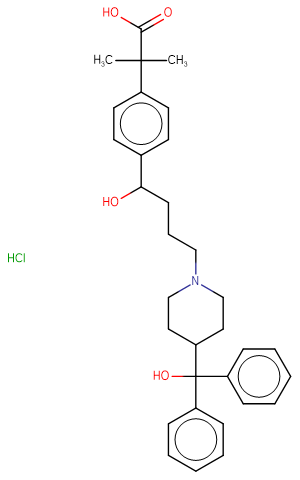
Fexofenadine hydrochloride b
CAS No. 153439-40-8
Fexofenadine hydrochloride b( Terfenidine carboxylate hydrochloride | MDL-16455 hydrochloride | Fexofenadine HCl | MDL 16455A | Telfast | Allegra )
Catalog No. M19417 CAS No. 153439-40-8
Fexofenadine is a second generation antihistamine that is used for the treatment of allergic rhinitis angioedema and chronic urticaria.
Purity : >98% (HPLC)
 COA
Datasheet
HNMR
HPLC
MSDS
Handing Instructions
COA
Datasheet
HNMR
HPLC
MSDS
Handing Instructions
| Size | Price / USD | Stock | Quantity |
| 10MG | 41 | In Stock |


|
| 25MG | 64 | In Stock |
|
| 50MG | 87 | In Stock |
|
| 100MG | Get Quote | In Stock |
|
| 200MG | Get Quote | In Stock |
|
| 500MG | Get Quote | In Stock |
|
| 1G | Get Quote | In Stock |
|
Biological Information
-
Product NameFexofenadine hydrochloride b
-
NoteResearch use only, not for human use.
-
Brief DescriptionFexofenadine is a second generation antihistamine that is used for the treatment of allergic rhinitis angioedema and chronic urticaria.
-
DescriptionFexofenadine is a second generation antihistamine that is used for the treatment of allergic rhinitis angioedema and chronic urticaria.
-
In VitroFexofenadine (1-100 μM; 1 h) inhibits the expression of IL-6 protein in nasal fibroblasts in a dose-dependent manner.Fexofenadine (1-100 μM; 1 h) blocks phosphorylated p38 activation in histamine-induced nasal fibroblasts, but shows no effect on either pERK or pJNK.Western Blot Analysis Cell Line:Nasal Fibroblasts Concentration:100 μM Incubation Time:1 hourResult:Blocked pp38 activation in histamine-induced nasal fibroblasts, showed histamine-induced IL-6 production mediated by the p38 pathway.
-
In VivoFexofenadine hydrochloride (oral administration; 5-20 mg/kg; once daily; 3 w) suppresses both eosinophilia and systemic anaphylaxis in C57BL/6 mice infected with T. spiralis. Animal Model:C57BL/6 mice infected with Trichinella spiralis Dosage:5, 10 and 20 mg/kg Administration:Oral administration; 5, 10 and 20 mg/kg; once daily; 3 weeks Result:Inhibited eosinophilia in a dose-dependent manner.Suppressed the decrease in rectal temperature (p<0.01), a marker for systemic anaphylaxis.
-
SynonymsTerfenidine carboxylate hydrochloride | MDL-16455 hydrochloride | Fexofenadine HCl | MDL 16455A | Telfast | Allegra
-
PathwayGPCR/G Protein
-
TargetHistamine Receptor
-
RecptorHistamine H1 receptor
-
Research AreaMetabolic Disease
-
IndicationAllergic rhinitis; Urticaria
Chemical Information
-
CAS Number153439-40-8
-
Formula Weight538.13
-
Molecular FormulaC32H39NO4·HCl
-
Purity>98% (HPLC)
-
SolubilityDMSO:26.9 mg/mL (50 mM)
-
SMILESCl.CC(C)(C(O)=O)c1ccc(cc1)C(O)CCCN1CCC(CC1)C(O)(c1ccccc1)c1ccccc1
-
Chemical Name——
Shipping & Storage Information
-
Storage(-20℃)
-
ShippingWith Ice Pack
-
Stability≥ 2 years
Reference
1.Bachert C et al. A review of the efficacy of desloratadine fexofenadine and levocetirizine in the treatment of nasal congestion in patients with allergic rhinitis. Clin Ther 31 (5): 921-44.
molnova catalog



related products
-
Esculetin
Esculetin is slightly soluble (in water) and a very weakly acidic compound (based on its pKa). Esculetin can be found in a number of food items such as dandelion, highbush blueberry, wild leek, and opium poppy.
-
Psoralenoside
Psoralenoside is a natural product isolated from the fruits of Psoralea corylifolia, shows estrogen-like activity, osteoblastic proliferation accelerating activity, antitumor effects and antibacterial activity.
-
MK-0249 B
MK-0249 is an orally active, selective and potent histamine H3 receptor antagonist (IC50: 1.7 nM) for the study of attention-deficit and hyperactivity disorders.
